If that sounds familiar, you may be a highly sensitive person. And if you've started looking for an IFS therapist in Washington State, you've probably seen "HSP" listed as a specialty on profile after profile.
Far fewer of those therapists know how to slow the work down for a nervous system that takes in more than most. That gap is worth closing before you book anyone.
TL;DR Quick Answers
IFS Therapist Washington State
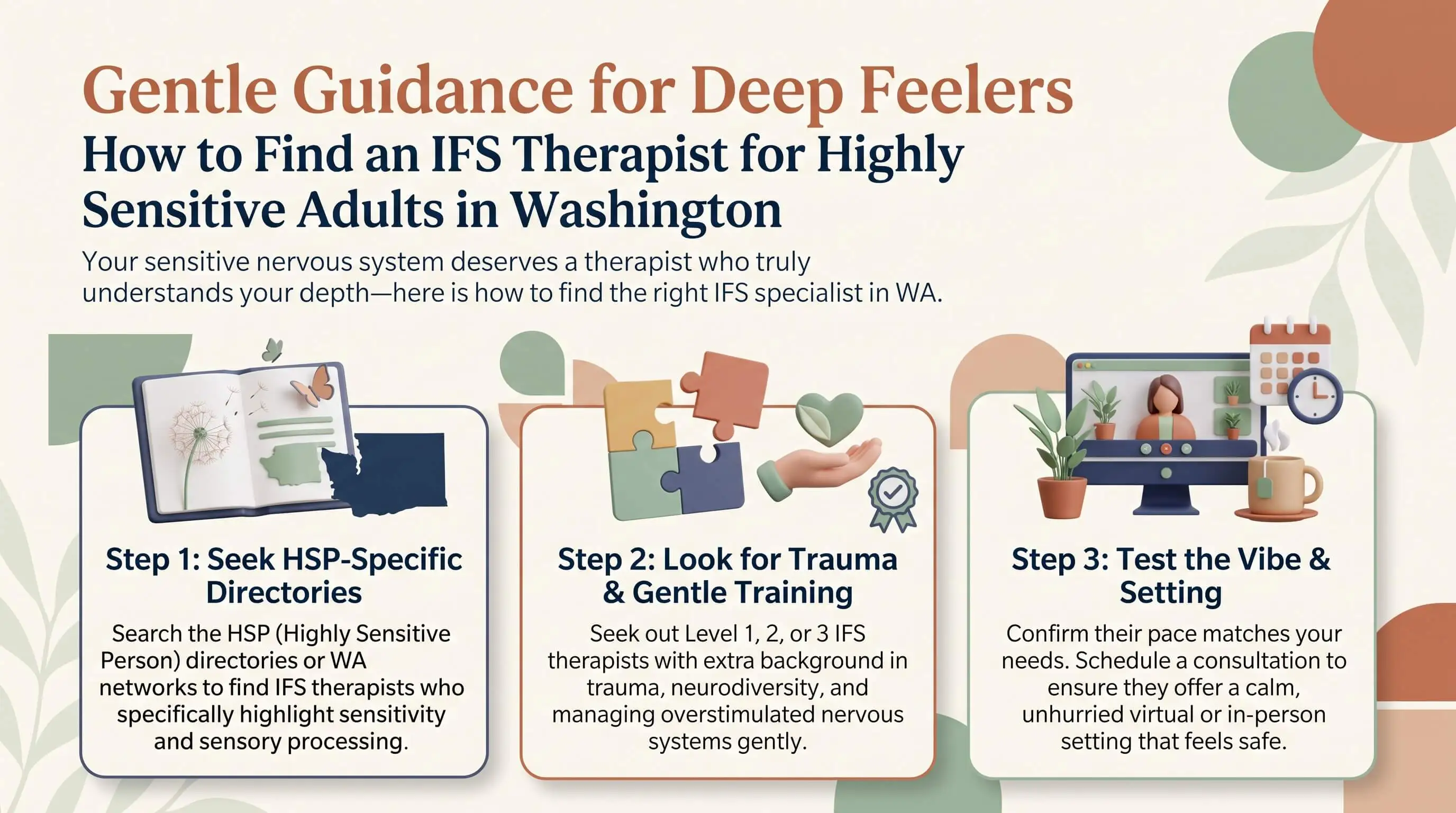
Look for a therapist licensed in Washington, such as an LMHC, LICSW, or LMFT, with IFS Institute training and hands-on experience with sensitive clients. Check the license on the state's credential search. Video sessions reach every county, provided you're in Washington when you meet.
IFS Therapy For Highly Sensitive People
IFS treats people-pleasing and shutting down as protective parts of doing a job. It moves at your system's pace and opens nothing early, which is why it tends to suit people who flood easily.
Online IFS Therapy In Washington
Online IFS works well for many sensitive adults, partly because home is usually the quietest room they have. You'll need a private space and a device with a camera, and headphones help. Many therapists offer a free consultation call so you can check the fit first.
Top Takeaways
Sensitivity is a trait. It isn't a disorder. Around a third of adults have it, and men have it as often as women.
IFS goes at your pace. It works with protective parts gently and opens nothing before you're ready.
Check the license yourself. Washington's credential search takes about a minute.
Ask how they handle overwhelm. The answer tells you more than a certificate on the wall.
The video reaches every county. You only need to be in Washington during the session.
What High Sensitivity Actually Means
Psychologist Elaine Aron has studied high sensitivity since 1991. She calls it sensory processing sensitivity, a temperament trait found in somewhere between a fifth and a third of people. That's too common to count as a disorder.
Sensitive people process things deeply. They feel a lot, catch small shifts in a room, and wear out faster when too much is coming in at once. The same wiring is why they notice what others miss and care so much about the people around them.
People rarely come to therapy because of the trait itself. They come after years of being told to manage it: You're too much. Toughen up. For a lot of men, Black men included, that message gets louder after childhood, until feeling deeply becomes something to hide. This site has written about where that silence comes from in breaking the mental health stigma in the Black community.
Why IFS Suits A Sensitive Nervous System
Most people already talk in parts. Part of me wants to go. Part of me wants to stay home.
Internal Family Systems takes that way of talking seriously, and Richard Schwartz built the whole model around it.
Some parts are protected. They plan ahead, keep everyone happy, criticize you before anyone else gets the chance, or shut everything down when it's too much. Other parts carry older hurt and stay out of sight. Underneath all of them is what IFS calls the Self, the steady, curious center that can listen without panicking.
Sensitive people tend to recognize their protectors fast. The one scanning every face for disappointment, for instance, or the one that goes blank halfway through a crowded party.
IFS doesn't argue with any of them. You get to know each one slowly, and nothing gets opened before your system is ready. For someone who floods easily, that pace decides whether therapy helps or just adds to the pile.
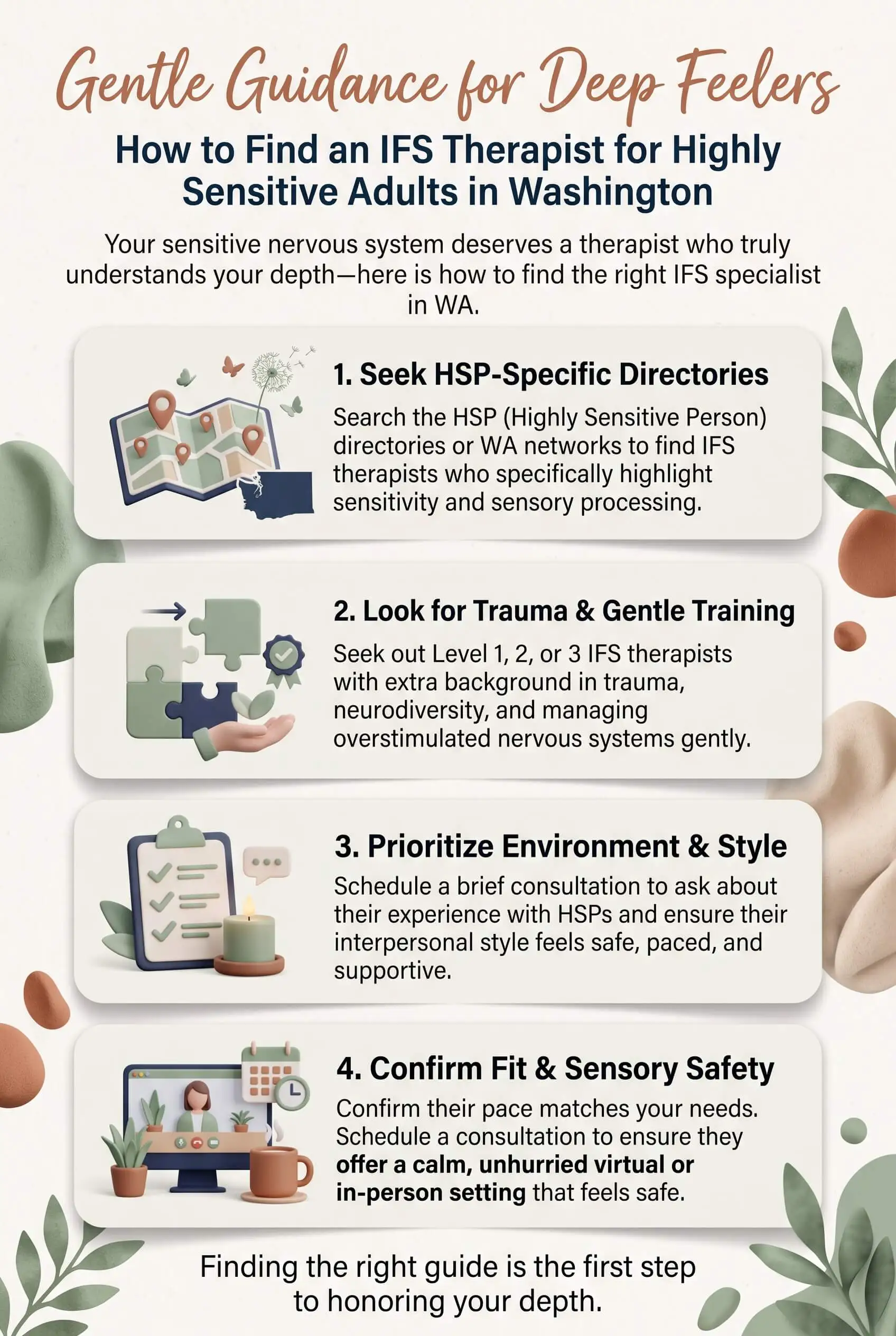
6 Things To Check Before You Book In Washington
Credentials matter, though fit usually matters more. These checks will save you a few wasted first sessions.
A Washington license. Look for an LMHC, LICSW, LMFT, or licensed psychologist, then look the person up yourself on the Department of Health's credential search. It takes about a minute.
Formal IFS training. Ask where they trained. IFS Institute training, Level 1 or beyond, is the clearest signal you'll get. Certification is a further step some therapists take. "IFS-informed" might mean a weekend workshop.
Experience with sensitive clients. Ask, "What do you do when someone gets overwhelmed in session?" Listen for specifics. Reassurance on its own doesn't tell you much.
A place you can live with. Ask whether you can turn the camera off or stop partway through on a hard day. You should be able to say "that's enough for today" without apologizing.
Cultural fit. You shouldn't have to explain where you come from before you can talk about your life. Ask how they work with clients who share your background, because cultural competency in health care shapes whether you'll feel safe enough to keep coming back.
Clear costs. Ask which insurance plans they're in-network with. If you're paying out of pocket, you're usually entitled to a written Good Faith Estimate before the first session.
Online IFS Therapy Across Washington State
In a lot of small Washington towns, the nearest IFS-trained therapist is a long drive away. Video closes most of that distance.
There's one rule. You need to be physically in Washington during each session, because that's where your therapist holds a license.
For sensitive people, staying home can work in your favor. You skip the waiting room and the overhead lights and sit in your own chair, in a room you already know.
Lauren Rath, MA, LMHC, offers online IFS therapy for Washington adults from Spokane. She sees clients in Seattle, Tacoma, Vancouver, Bellingham, Olympia, Yakima, the Tri-Cities, and the small towns between them. She trained through the IFS Institute and has practiced IFS for seven years. She expected the screen to water the work down. It hasn't, and she's found that people sitting in their own space often settle in faster.
“Sensitive clients usually arrive apologizing for how much they feel. After seven years of IFS work, I’d point to a protector instead, one that’s been shouting ‘too much’ since they were small. When we slow down enough for that part to be heard, it often eases on its own, and the shame lifts while the sensitivity stays put.”
7 Essential Resources
Where to look while you're still deciding. None of these will hurry you.
Find Out Whether The Trait Fits You
Elaine Aron has researched high sensitivity since 1991. Her site has a free self-test. It also has plain-language research summaries and a section just for sensitive men.
Source: The Highly Sensitive Person, Elaine Aron's Research Site
Search IFS-Trained Therapists By State
You can filter the IFS Institute's directory by state and by training level. The Institute doesn't check licenses itself, so run any name you find through the next resource too.
Source: IFS Institute Directory
Confirm A Washington License In About A Minute
Search any provider by name on the state Department of Health's site. You'll see whether the license is active and whether there's any disciplinary history.
Source: Washington State Provider Credential Search
Walk Into The First Call With Questions Ready
NAMI's guide lists the questions worth asking on a first visit. It also says plainly that if the first person doesn't feel right, you move to the next name on your list.
Source: Finding A Mental Health Professional (NAMI)
Get Set Up For Video Sessions
The federal telehealth site lists the mental health services that work by video and links to a tip sheet for behavioral health visits.
Source: Telehealth For Behavioral Health Care (HHS)
Know What You'll Pay Before You Start
Without insurance, most providers have to give you a written Good Faith Estimate when you schedule at least three business days ahead. CMS explains what it should include and what to do if you never get one.
Source: What Is A Good Faith Estimate? (CMS)
Have Someone To Talk To While You Search
Finding the right fit can take a few weeks. The 988 Lifeline is free and confidential by call, text, or chat, and its site walks you through who answers and what they'll ask.
Source: What To Expect From The 988 Lifeline
3 Supporting Statistics
Three numbers worth keeping in mind as you look.
About A Third Of Adults Are Highly Sensitive
In a 2018 study of 906 adults published in Translational Psychiatry, 31% landed in the high-sensitivity group. Another 40% fell in the middle, and 29% scored low.
Close to one in three.
If you're the one in the room taking everything in, a few other people there are probably doing the same.
Source: Lionetti Et Al., "Dandelions, Tulips And Orchids" (2018)
Sensitive Men Are As Common As Sensitive Women
Elaine Aron's research finds as many highly sensitive men as women. Sensitivity is more accepted in women, so men tend to hide it.
Men carry the trait just as often and get far less permission to show it.
A therapist who won't read sensitivity as weakness is worth the extra search.
Source: The Highly Sensitive Person, Elaine Aron's Research Site
Fewer Than Half Of Adults With Generalized Anxiety Get Treatment
Generalized anxiety disorder affects 6.8 million U.S. adults, and only 43.2% are receiving treatment.
High sensitivity and anxiety are different things, though years of overwhelm can leave someone carrying both.
Cost and distance keep people from care, and so does the nerve it takes to send a first email. Video takes distance off the table, which counts for something.
Source: Anxiety Disorders Facts And Statistics (ADAA)
Research suggests that about one in three adults is highly sensitive, with men experiencing this trait just as often as women, even though many feel pressured to hide it. Meanwhile, fewer than half of adults with generalized anxiety disorder receive treatment, highlighting the importance of addressing health disparities and improving access to mental health care. Understanding sensitivity without treating it as a weakness can help people find the support they deserve.
Final Thoughts And Opinion
Therapy for a sensitive person should treat sensitivity as information, something to listen to rather than shrink.
That's why the therapist matters as much as the method. Someone who pushes fast confirms the oldest fear a sensitive person carries, that they're too much. Someone who slows down shows them that every part of them can be met, one at a time, and nothing falls apart.
IFS is built for that pace. Nobody asks you to toughen up or push through. Instead you get curious about the voice in your head, and that small change tends to matter more than it sounds.
Four things worth holding onto while you search:
A license gets a therapist in the door, and fit decides whether you stay.
A good first call should leave you a little calmer than you were before it.
Asking a therapist to slow down is fair. The good ones are glad you said it.
For many sensitive people, home is the quietest room they have, so online sessions are often the better choice.
And to the men reading this: if you've spent years hiding how much you feel, know that you don't have to carry everything alone. Having IFS therapy explained may help you understand the parts of yourself that learned to stay strong, stay quiet, or push difficult feelings aside. Those parts deserve understanding, too.
Frequently Asked Questions
Q: Is IFS Therapy A Good Fit For Highly Sensitive People?
A: Often, yes. IFS treats reactions like shutting down or people-pleasing as parts trying to protect you, and it moves only as fast as your system can manage. That tends to suit people who flood easily. No approach fits everyone, so a free consultation is still the surest way to find out for yourself.
Q: Is Being Highly Sensitive A Mental Health Disorder?
A: No. Elaine Aron, who first described the trait, notes it shows up in 20 to 30% of people, which is too many to call a disorder. Sensitive people can also live with anxiety, depression, or trauma, and therapy can help with those. The trait itself isn't what therapy sets out to change.
Q: How Do I Check Whether An IFS Therapist Is Licensed In Washington?
A: Search their name on the Washington State Department of Health's Provider Credential Search. You'll see whether the license is active and whether there's any disciplinary history. After that, ask where they trained in IFS.
Q: Can I Do IFS Therapy Online In Washington State?
A: Yes. A therapist licensed in Washington can see you by video anywhere in the state, as long as you're physically in Washington for each session. If you're out of state that week, plan to reschedule.
Q: What Should A Highly Sensitive Person Ask Before Starting?
A: Ask what the therapist does when a client gets overwhelmed, and whether you can pause or turn the camera off. Ask about their IFS training too. Then notice how your body feels during the call.
Q: What's The Difference Between IFS-Trained And IFS-Informed?
A: IFS-trained usually means formal training through the IFS Institute, starting at Level 1. IFS-informed can mean anything from a workshop to a couple of books. Either can be useful, and it's fair to ask exactly what the training involved.
Q: How Long Does IFS Therapy Take?
A: Nobody can honestly give you a number up front. Some people notice a shift within a couple of months. Work with older people usually moves slower, and a good therapist will talk with you openly about pace along the way.
Q: Will Insurance Cover IFS Therapy In Washington?
A: Often, if the therapist is in-network with your plan. Coverage generally follows the therapist's license and network status rather than the specific approach. Paying out of pocket, ask for a written Good Faith Estimate before you begin.
Take The First Step
Writing to a therapist for the first time is harder than it looks from the outside. Some part of you may already be drafting reasons to wait until next month.
You don't need the right words. One sentence will do.
If you're in Washington and want someone who'll go at your pace, Lauren Rath offers a free 15-minute call to see how it feels. Read more about working with her as an IFS therapist in Washington State, then book whenever you're ready.