
Here's the short answer to finding an IFS therapist in Bellingham, WA: filter a directory for Internal Family Systems, confirm the Washington license, ask about IFS training, and use a free consultation to see how the conversation sits with you. If every local name has a waitlist, look at online IFS therapy anywhere in the state.
Plenty of men put this off for years. Some of us grew up being told to handle it and keep moving. Some tried therapy once and walked out feeling like a chart on a clipboard. If that's you, reading this far already counts as a start.
Most of the practical side goes faster than people expect. A license check, for one, takes about a minute.
TL;DR Quick Answers
IFS Therapist Bellingham WA
Bellingham has few IFS-trained clinicians, and many keep waitlists. Start with a filtered directory, then widen your search to online therapists licensed anywhere in Washington.
Where to look: Psychology Today's IFS filter, the IFS Institute directory, Therapy for Black Men, and your insurer's directory.
How to verify: Look up the license on the Washington State DOH Provider Credential Search.
What to ask: IFS training level (certification is a separate step), experience with men and Black clients, and insurance.
Online option: Video sessions open up every Washington-licensed IFS therapist, as long as you're in the state during sessions.
First step: Book free consults with two or three clinicians and notice who feels steadiest to talk to.
The short version: nothing in you is broken, and the right IFS therapist lets your parts set the pace.
Top Takeaways
Filter a directory for Internal Family Systems and contact three or four clinicians at once, since Bellingham waitlists are common.
Check every license on the Washington State Department of Health Provider Credential Search before you book.
Ask about IFS training level, then confirm it in the IFS Institute directory.
Treat cultural fit as part of clinical fit, and ask about it directly.
Online IFS therapy opens up every Washington-licensed clinician, as long as you're in the state during sessions.
What IFS Therapy Actually Is
IFS, in a sentence: your mind is made of parts, and none of them are the enemy.
Richard Schwartz built Internal Family Systems around something people already say without thinking. A part of me wants to call. A part of me would rather not.
One part keeps you guarded at work. Another stays busy so nobody sees you struggling. Another is still holding something from when you were eleven. IFS treats each of them like an employee who took a hard job years ago and was never told they could quit.
Underneath them is what IFS calls Self, the steady, curious center that's still there on the days it doesn't feel like it. The work is letting your parts meet that Self instead of fighting them off. For a lot of men, that lands very differently from being asked what's wrong with you.
Why Fit Matters More for Black Men
Black men get mental health care less often than most groups, even when they need it, and the reasons aren't mysterious. Some of it is stigma at home and in church, along with generations of earned distrust toward medical systems. Some of it is plain logistics: copays, shift schedules, and the exhaustion of explaining your whole life to a stranger before any real work begins.
So fit matters as much as method. The right IFS therapist welcomes the part of you that doubts all this and respects your culture without asking you to teach it. You set the pace. Understanding hеаlth dіspаrіtіеs in mental health care also helps explain why culturally responsive support matters. Our pieces on mental health stigma in the Black community and on depression in the Black community go deeper on why.
Where to Look for an IFS Therapist in Bellingham, WA
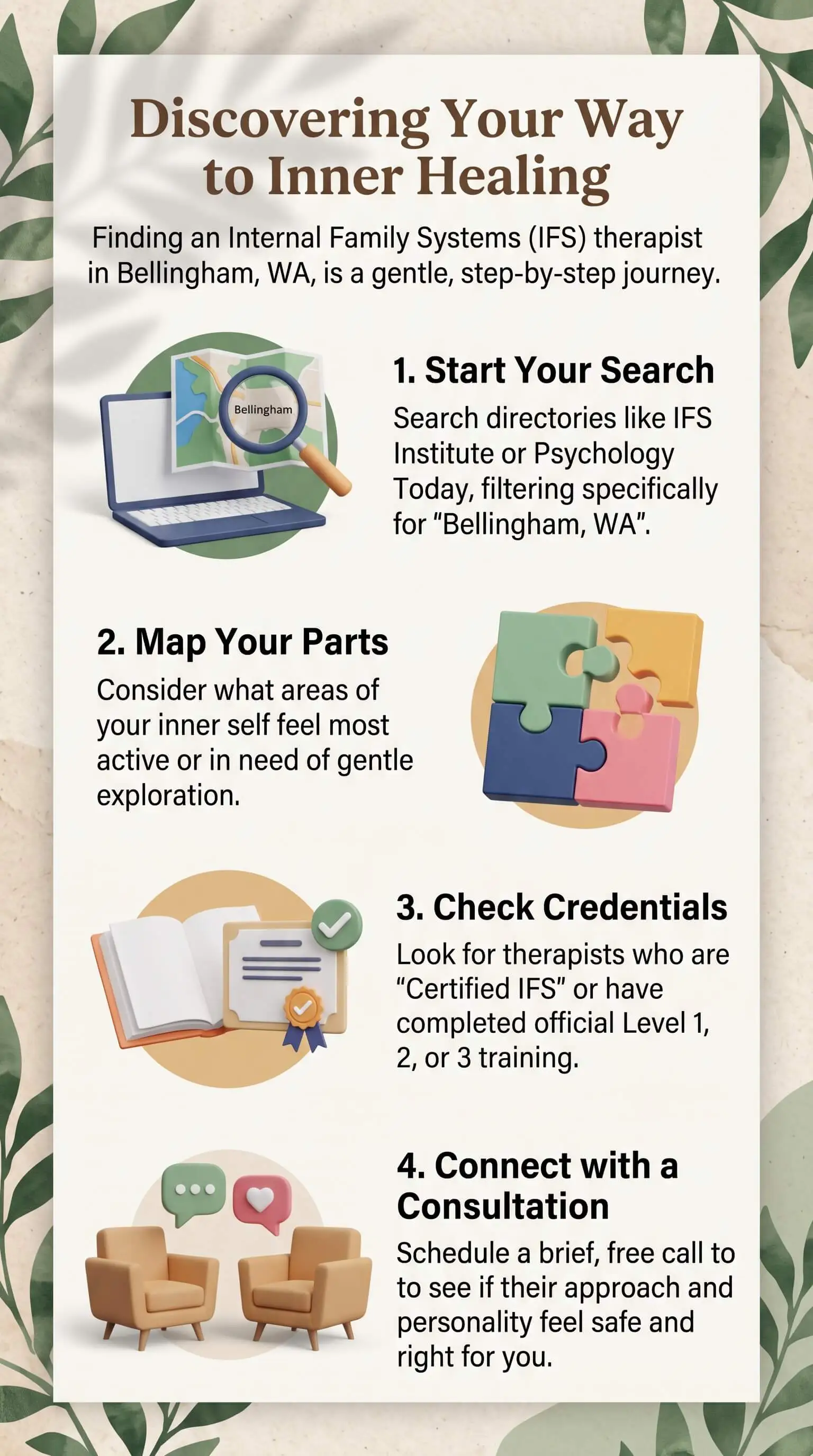
Start with a directory you can filter, then cast a wider net than feels necessary.
Psychology Today: Filter Bellingham for Internal Family Systems and look for "accepting new clients" on each profile.
IFS Institute practitioner directory: Search by city, then filter by training level and certification.
Therapy for Black Men: Built to connect men of color with therapists who name cultural competence in their work.
Your insurance plan's directory: The quickest way to see who's in-network before you get attached to someone who isn't.
Your doctor: A primary care referral can save you weeks of cold emails.
Whatcom County doesn't have a deep bench of IFS clinicians, and plenty of Bellingham listings say "waitlist." Reach out to three or four at once. Nobody will be offended.
Check That Your Therapist Is Actually Licensed
In Washington, you're looking for an LMHC, LICSW, LMFT or licensed psychologist. "Associate" after any of those means the clinician practices under supervision, which is fine and worth knowing.
The Washington State Department of Health Provider Credential Search takes about a minute. Type in a name and you'll see license status and any public disciplinary history.
Then ask about IFS training. The IFS Institute offers Level 1, 2 and 3 trainings, and certification is a separate step beyond those. Level 1 is a real foundation. More training doesn't guarantee a better fit, but you should know what you're getting.
Questions to Ask Before You Book
What IFS training have you done, and where?
Is IFS your main approach, or one tool among several?
Have you worked with men, and with Black clients, on the kind of thing I'm bringing?
Are you in-network with my plan, and if not, what will I pay?
Do you see people online, in person, or both?
What happens in the first session?
Notice how you feel while they answer, not only what they say. That reaction is information too.
In-Person or Online IFS Therapy in Bellingham?
An office works for some people. For others, the weekly drive on I-5, circling Fairhaven for parking, or timing a ferry from the islands in February rain becomes the quiet reason they stop going.
Online sessions take that off the table. Washington lets you see any clinician licensed in the state over secure video, as long as you're physically in Washington during the session. Your options stop at the state line instead of the county line.
Lauren Rath Therapy is one example. Lauren offers online IFS therapy for adults, works mainly with trauma, anxiety, attachment and perfectionism, and is in-network with BCBS, Aetna, Regence, Premera and Cigna.
All you need is a private room and a camera on a connection that doesn't drop.
Get the Cost in Writing Before You Commit
Insurance usually covers therapy by the clinician's license type rather than the method, so ask whether a therapist is in-network and what your copay or deductible looks like. If you're paying out of pocket, you can ask for a Good Faith Estimate before your first session. Some therapists will also give you a superbill to send to your insurer for out-of-network reimbursement.
If You Need Someone to Talk to Now
A good fit can take a few weeks to find. In the meantime, the NAMI HelpLine offers free peer support, information and referrals on weekdays from 7 a.m. to 7 p.m. Pacific. Call 1-800-950-NAMI (6264) or text "helpline" to 62640.
The HelpLine isn't a crisis line. If you're in crisis, call or text 988 any hour of the day. If someone is in immediate danger, call 911.
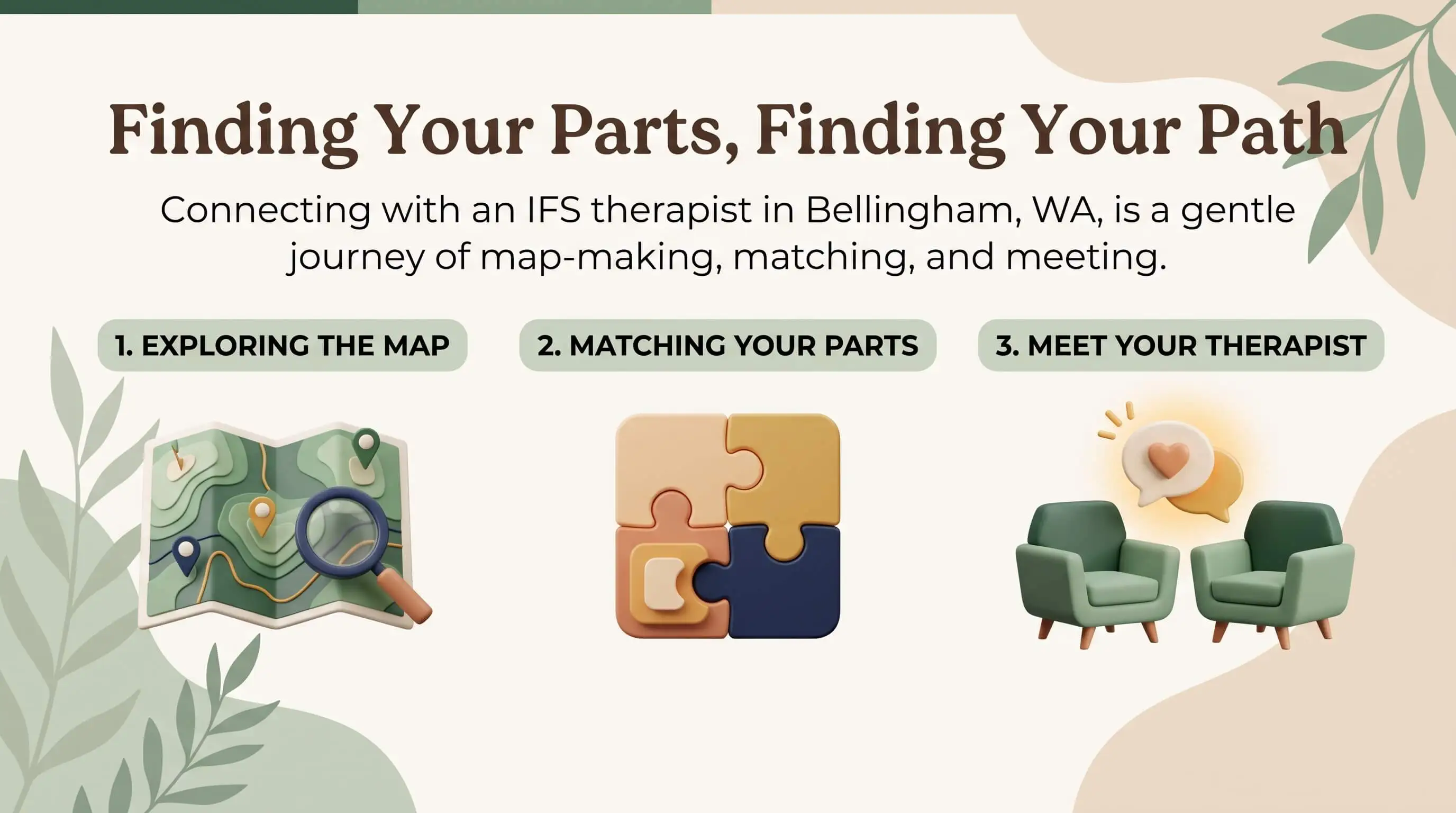
“Many of the people who find me have spent years handling everything on their own, and the part of them that keeps watch is tired. In IFS, I don’t ask that part to stand down. I ask what it’s been protecting, and then I wait. I’ve seen that question land over video more gently than I expected, from a parked truck or a back bedroom, because people are already somewhere they feel safe. The skeptical part is welcome too. It usually asks the best questions.”
7 Essential Resources
NAMI HelpLine: Free peer support and referrals by phone, text, chat or email, weekdays 7 a.m. to 7 p.m. Pacific.
988 Suicide & Crisis Lifeline: Call, text or chat 988 any hour. Free and confidential.
Washington State DOH Provider Credential Search: Look up any therapist's license and public disciplinary history in about a minute.
IFS Institute Practitioner Directory: Search by city, then filter by training level and certification.
Psychology Today: IFS Therapists in Bellingham, WA: Fees, insurance and openings, side by side.
Therapy for Black Men: A directory built to connect men of color with culturally competent therapists and coaches.
FindTreatment.gov: SAMHSA's confidential, anonymous search for mental health and substance use care.
3 Statistics
Men get care less often than women. Among U.S. adults with a mental illness in the past year, 42.1% of men received treatment, compared with 59.2% of women. (SAMHSA, 2024 NSDUH)
Black adults fall further behind. In 2025, 40.5% of Black adults with a mental illness got treatment, against 50.9% of U.S. adults overall. (Black Health, from SAMHSA NSDUH tables)
IFS has early promise for trauma. In a small pilot study of adults with childhood trauma and chronic PTSD, 92% no longer met PTSD criteria after IFS treatment. One uncontrolled pilot can't settle anything, but it's a hopeful start. (IFS Institute research summary)
Mental health treatment remains less accessible for men and Black adults, highlighting ongoing gaps in care. While early research suggests IFS therapy may help people with trauma and PTSD, more studies are needed to confirm its effectiveness. These findings emphasize the importance of healthcare professionals providing culturally responsive, accessible mental health support and exploring promising approaches like IFS therapy.
Final Thoughts and Opinion
I'll be honest about where I've landed: fit matters more than distance.
A therapist ten minutes from your house who makes you feel like you have to perform isn't your therapist. A Washington-licensed IFS clinician on a laptop in your living room, one who lets your guarded parts take their time, might be. Closing is convenient. Feeling understood is what gets you to session six.
For Black men, this search can feel like one more room where you have to prove you belong. You don't. You're allowed to ask pointed questions in every free consultation and walk away from anyone who doesn't sit right.
If a friend asked me where to start, I'd tell him four things:
Check the license before anything else.
Ask about IFS training and confirm it in the IFS Institute directory.
Say out loud that culture matters to you, then watch how they respond.
Don't rule out online just because it's unfamiliar.
After that, trust what you notice in the first conversation. Whatever you're carrying took years to pick up. The right person won't ask you to drop it in a week.
Frequently Asked Questions
Q: How do I find an IFS therapist in Bellingham, WA?
A: Filter Psychology Today or the IFS Institute directory for Internal Family Systems in Bellingham, then confirm each clinician's Washington license. Book a free consultation with two or three and go with the one who feels steadiest to talk to.
Q: What is IFS therapy, in plain terms?
A: IFS sees your mind as a set of parts, each trying to protect you in its own way. You get to know those parts with curiosity instead of fighting them, and that tends to bring you back to a calmer center called Self.
Q: Does insurance cover IFS therapy in Washington?
A: Often, yes, because insurers usually cover therapy by license type rather than method. Ask whether the therapist is in-network with your plan. If you're paying yourself, request a Good Faith Estimate first.
Q: Is online IFS therapy as effective as in-person?
A: Many clients and clinicians find it works well. Lauren Rath, who practices IFS online across Washington, says that in her experience it does, even though she expected otherwise.
Q: What's the difference between IFS-trained and IFS-certified?
A: The IFS Institute offers Level 1, 2 and 3 training. Certification is a separate, advanced process where a clinician shows competence in the model, and both appear in the Institute's directory.
Q: How do I check a therapist's license in Washington?
A: Use the Washington State Department of Health Provider Credential Search. Enter a name or credential number to see license status and any public disciplinary actions.
Q: Can I find a Black or culturally responsive IFS therapist near Bellingham?
A: It takes some looking. Start with Therapy for Black Men, ask every clinician about their experience with Black clients, and widen your search to online therapists across Washington.
Q: What if I need help before I get an appointment?
A: The NAMI HelpLine offers free peer support and referrals on weekdays. In a crisis, call or text 988 any hour, and if someone is in immediate danger, call 911.
Start With One Conversation
You don't need the right words or any certainty that IFS is for you. A free 15-minute consult with a Washington-licensed IFS therapist for anxiety is enough to find out, with no cost and no obligation. Whether you're in Bellingham or anywhere else in the state, send one message whenever you're ready. A single sentence is plenty.


